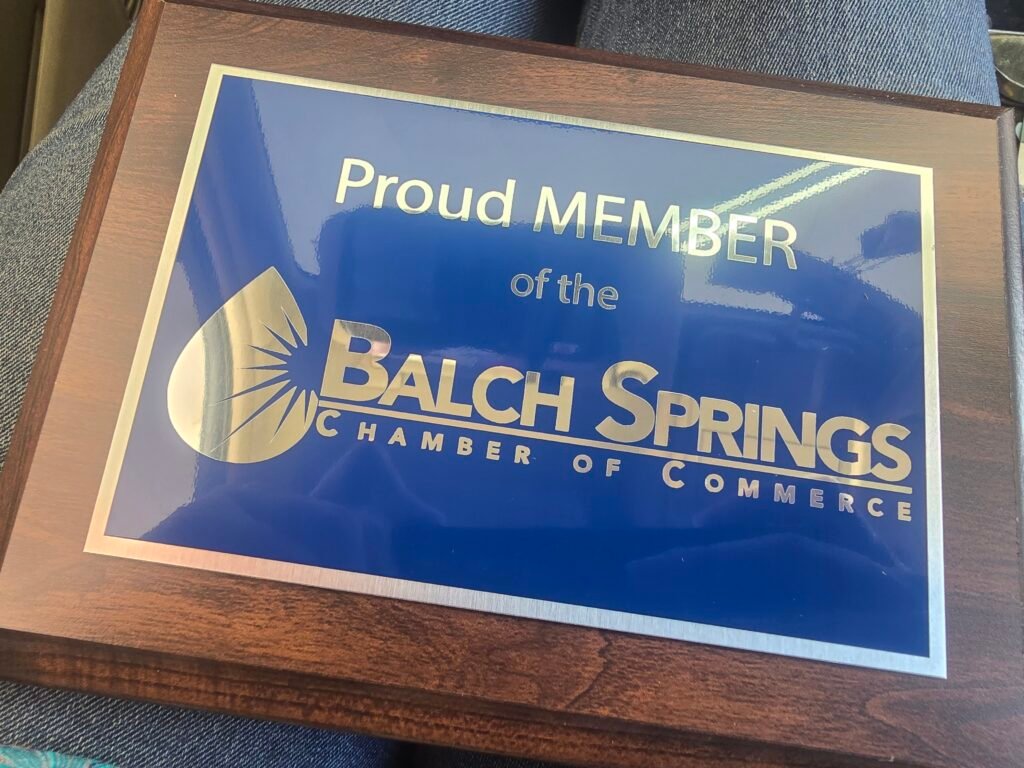
We’re celebrating a new milestone for Rooted Futures Collective: we are officially the newest member of the Balch Springs Chamber of Commerce!
For RFC, this is about much more than adding another membership to our résumé. It is an opportunity to bring something genuinely different into the local conversation about business, community development, and the future of Balch Springs.
Additionally, Rooted Futures Collective occupies an unusual space in our community. While many organizations focus on social services, civic engagement, education, economic development, or neighborhood improvement, RFC brings those conversations together with conservation biology, ecological restoration, biodiversity, environmental education, green infrastructure, and regenerative community development.
That combination is still relatively uncommon in the area.
…and we think it matters.
Bringing a Different Kind of Nonprofit to the Table
Environmental organizations are often associated with distant wilderness, large conservation areas, or regional advocacy.
RFC was intentionally built around a different question:
What does conservation look like when it begins right here, in the places where people already live, work, learn, shop, and gather?
Our work is rooted in urban and suburban communities like Balch Springs, where environmental challenges are inseparable from everyday community life.
Heat, flooding, water use, declining biodiversity, loss of native habitat, food access, aging infrastructure, neighborhood appearance, public space, education, and economic opportunity all overlap.
That means ecological restoration cannot exist in its own little bubble.
It has to involve residents.
It has to involve businesses.
It has to involve schools, libraries, civic organizations, local government, property owners, volunteers, and community leaders.
RFC was created to help build those connections.
Conservation Is Community Development
One of the ideas at the heart of Rooted Futures Collective is that environmental stewardship should not be treated as something separate from economic or community development.
Native landscaping can reduce water demand and long-term maintenance needs.
Urban tree canopy can help reduce extreme heat.
Healthy soils and native vegetation can improve stormwater infiltration.
Pollinator habitat can restore pieces of ecosystems that have nearly disappeared from developed landscapes.
Composting and material-reuse programs can reduce waste while creating useful community resources.
Outdoor learning spaces can turn ordinary public property into places where children and adults can experience ecology rather than simply read about it.
These are environmental benefits, but they are also community assets, and many of them create opportunities for local businesses.
Landscape companies can develop expertise in native landscapes. Contractors and suppliers can support green infrastructure projects. Nurseries can expand native plant offerings. Local businesses can sponsor restoration and education projects. Employers can provide volunteers. Restaurants and institutions may eventually participate in composting or waste-diversion programs.
A regenerative local economy is not one where environmental responsibility competes with business.
It is one where the two reinforce each other.
A Living Example at the Balch Springs Library
One of the clearest examples of RFC’s approach is the Future Ancestors Learning Garden, being developed in partnership with the Friends of the Balch Springs Library.
The project is transforming library grounds into a living outdoor learning environment centered on native habitat, pollinators, ecological restoration, food-growing systems, water conservation, and hands-on community education.
It is not simply a garden.
It is intended to become a demonstration of what public space can do.
Children will be able to encounter native plants, insects, birds, soil, and food systems firsthand. Residents can learn practical skills they can apply at home. Community members can participate in stewardship, and local organizations and businesses can help build something with visible, lasting value.
The Learning Garden reflects what makes RFC different: we are not interested only in talking about sustainability. We want to create places where people can see it, touch it, learn from it, and participate in it.
Connecting Ecology With the Local Economy
Our Chamber membership also creates opportunities that traditional environmental networks alone cannot provide.
A restoration organization might need trees, soil, lumber, irrigation materials, printing, equipment, transportation, construction expertise, financial support, volunteers, or professional services.
Those resources already exist within local economies.
Often, the missing ingredient is simply connection.
A contractor may have equipment that can support a habitat project.
A nursery may become a source for locally appropriate native plants.
A landscaping company may discover an emerging market in native landscape installation and maintenance.
A local employer may sponsor environmental education or organize a volunteer workday.
A bank or professional services firm may help strengthen the organizational capacity behind community projects.
The Chamber gives RFC another way to build those relationships while also introducing local businesses to practical forms of sustainability that can benefit their properties, customers, employees, and community.
Why Balch Springs?
RFC’s work is especially meaningful here because Balch Springs sits within one of North America’s most heavily altered ecosystems: the Blackland Prairie.
Only a tiny fraction of the original prairie remains intact.
Yet fragments of that ecological history are still present all around us, in native plants, remnant habitat, waterways, roadside vegetation, vacant land, parks, and even ordinary backyards.
Our community has an opportunity to decide whether those fragments disappear quietly or become the foundation for restoration.
That is where RFC comes in.
We are working to make conservation something local, visible, practical, and participatory.
Not somewhere else.
Not someday.
Here. Now.
Growing With Balch Springs
Rooted Futures Collective is proud to be one of the Chamber’s newest members, and we are especially proud to bring a new kind of voice into the organization.
As RFC continues developing ecological education, native habitat restoration, biodiversity research, green infrastructure, community stewardship, and regenerative development initiatives, we want those efforts to grow alongside the businesses and institutions that make Balch Springs what it is.
We believe environmental stewardship can create opportunity rather than restriction.
We believe restoration projects can strengthen local economies.
We believe sustainability should be accessible to ordinary communities, not reserved for wealthy cities or sprawling conservation organizations.
…and we believe some of the strongest solutions will emerge when nonprofits, residents, businesses, educators, civic organizations, and local government stop treating environmental, economic, and social issues as separate problems.
Rooted Futures Collective exists at the intersection of those worlds.
Joining the Balch Springs Chamber of Commerce gives us another place to bring them together.
We’re incredibly excited to see what grows from here!
Educate. Organize. Regenerate.
Want to Help Us Grow?
Rooted Futures Collective is growing, and there are plenty of ways to be part of what comes next. Whether you want to volunteer your time, partner with us on a project, sponsor our work, support a community initiative, or simply stay connected, we’d love to have you involved.
Visit our Get Involved page to explore opportunities to volunteer, partner, sponsor, and support RFC’s work. You can also use our interest forms to tell us a little about how you’d like to participate, and we’ll help connect you with the right opportunity.
Businesses and organizations interested in collaborating with RFC are especially encouraged to reach out. From project sponsorships and donated materials to expertise, employee volunteer days, and long-term partnerships, there are many ways to help build a more resilient, ecologically healthy community.
However you choose to get involved, there’s a place for you in this work.